
BreedSmart helps Thoroughbred breeders and buyers use data to assess their options. It brings estimates of success and their uncertainty into decisions about matings, stud fees, and yearling purchases, so those decisions can reflect the goals and costs that matter to each user.
What you can do with BreedSmart
BreedSmart Workspace brings several decisions into one place. You can compare stallions and their fees, assess the estimated success probability of a proposed stallion–mare mating, and explore how your options change when breeding to race versus breeding to sell. Buyers can also evaluate yearling purchases, comparing estimated racing success, sale prices, and campaign costs.
You begin with your goal, mare, or shortlist. The tools help you compare the available options and understand the uncertainty behind the numbers, while leaving the final choice to you.
The odds are not printed on the ticket
Every breeding or yearling purchase is a decision about an uncertain future. In that sense, it resembles buying a lottery ticket: you commit money today to an outcome you cannot know in advance.
But there are two important differences. First, you decide what counts as success. You might aim to breed a Grade 1 winner at three, buy a horse capable of competing at a particular level, or produce a yearling that sells profitably. Each goal defines a different event and a different probability.
Second, the odds are not printed on the ticket. They have to be estimated. Different matings and yearlings can have different chances of reaching the same goal, and we do not know those chances precisely.
An underlying probability we cannot observe
Imagine that we could repeat the same stallion–mare mating millions of times across parallel universes, under the same defined starting conditions, allowing inheritance and subsequent events to unfold differently each time. Some offspring would become Grade 1 winners at three. Most would not. Across enough repetitions, the proportion reaching that goal would reveal its underlying probability.
We cannot run that experiment. We observe a limited history of horses, pedigrees, racing performances, and sales, and use that evidence to infer the odds. For a yearling, the question is similar: given what we know about this horse, what is its probability of achieving our chosen goal?
There are therefore two layers of uncertainty. One concerns what will happen to the individual horse. The other concerns how accurately we have estimated its chance of success. Even if we knew the probability precisely, the individual outcome would remain uncertain.
A carefully selected mating can produce an unsuccessful racehorse, while a speculative purchase can produce a champion. The outcome alone does not establish whether the original decision was sound. A decision must also be assessed against the evidence and alternatives available when it was made.
Working backward from results to probabilities
Historical success rates provide useful evidence. Suppose one stallion has produced five stakes winners from 100 foals, and another has produced 50 from 1,000. Both observed rates are exactly 5%. But the underlying probability is unknown in each case. Several different probabilities could plausibly have generated either record, with much greater uncertainty in the smaller sample.
The same observed percentage can be consistent with a wide range of underlying probabilities. Both stallions have produced 5% stakes winners, but that does not tell us their true chances of producing one. More data helps narrow the range, as the graphic shows.
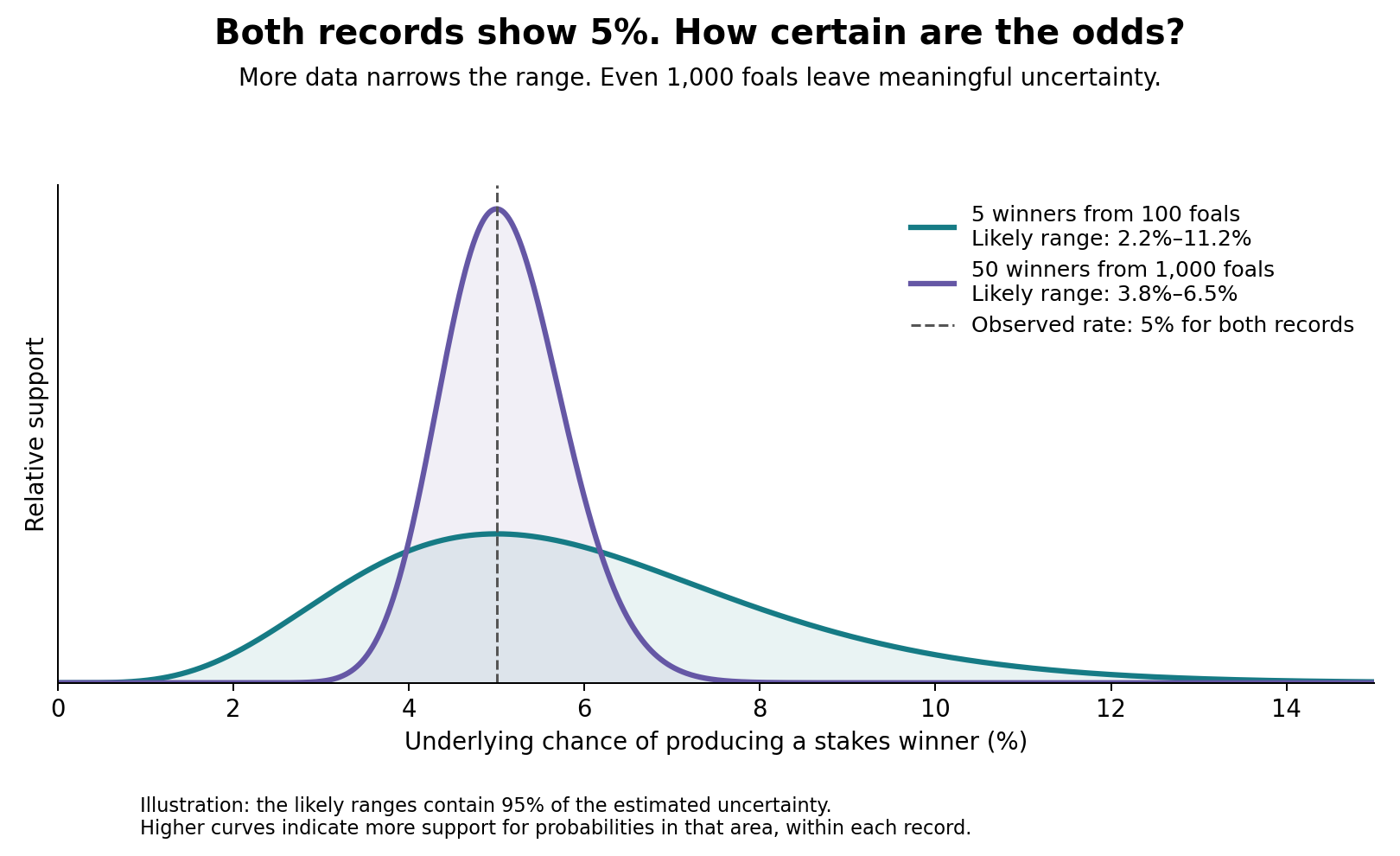
Even with 1,000 foals, substantial uncertainty remains. In this example, the estimated probability ranges from about 3.8% to 6.5%—roughly 70% higher at one end than the other. More evidence makes the estimate more precise, but it does not make the odds certain.
This illustration uses a simplified statistical model. The highlighted ranges contain 95% of the estimated uncertainty; values outside them remain possible. The calculation treats each foal as an independent outcome with the same chance of success within each group. Real breeding records also reflect differences in mares, management, and opportunity.
Evidence before breeding theory
BreedSmart works with real breeding, racing, and sales data. We select information for our models because it has been validated as useful for estimating probabilities of success. We do not adhere to a particular breeding theory; predictive evidence determines which information is useful.
Consider a nick: a particular combination of sire line and broodmare sire line. A few successful horses may suggest that the combination is promising, but a small sample can leave substantial uncertainty. We also need to consider the unsuccessful horses and other explanations, such as the strength of the maternal families, the mares’ own ability, and the opportunities their offspring received.
Finding a pattern in past winners is a starting point. Testing whether it helps predict outcomes in horses that were not used to discover it provides stronger evidence that it is useful.
From estimated odds to value
A probability estimate becomes useful when you consider what you would pay for it. If two tickets offer exactly the same prize and one has twice the probability of winning, its expected payout is twice as large. Under otherwise identical conditions, paying twice as much gives you the same expected payout per dollar.
If everyone knew those odds and valued the prize in the same way, prices could adjust to reflect them, making an advantage harder to find. In breeding and buying, however, the odds themselves are uncertain. People can assess the same horse differently, pursue different goals, and face different costs.
BreedSmart helps you bring these estimates and costs together. A higher chance of success may justify paying more, but it does not automatically justify twice the stud fee or purchase price. Other breeding, raising, and campaign costs also matter. A price that looks attractive under a confident assessment may look expensive under a cautious one.
Making the final choice
BreedSmart supports your decision; you make the choice. The model cannot capture every piece of information about a horse or every breeding theory you may consider. Your inspection of a yearling, knowledge of a mare, or assessment of a mating may give you reasons to be more confident or more skeptical than the model’s central estimate.
You choose where within the estimated distribution your own belief lies. You might work with a lower probability when you see reasons for caution, accept the central estimate, or use a higher probability when additional evidence supports greater confidence. Make that assessment consciously and be clear about the reasons behind it.
Choosing an optimistic estimate does not change the horse’s actual chance of success, and the distribution does not automatically account for information the model has not considered. Confidence in the odds is also separate from willingness to take a risk: two people can agree on the probabilities and still choose differently because their goals, budgets, and tolerance for loss differ.
BreedSmart provides a consistent basis for comparing the estimates, costs, and assumptions behind your options. You bring the additional knowledge and judgment, and make the final breeding or buying decision.
See BreedSmart in practice
For a worked example of the inputs, report outputs, and bidding decisions, read Buying a yearling using BreedSmart. It compares ten Keeneland September yearlings, including actual sale prices, in a sortable table.