
BreedSmart Workspace
Choose the tool for your next decision.
Find out what to enter, what each tool shows, and how to use the results in your breeding and buying decisions.
01 · Choose a stallion
Compare options before committing a stud fee.
Stallion comparison
Compare several stallions against a benchmark when you want a general view of value for your breeding goal.
- You enter
- A benchmark stallion and fee, comparison stallions and quoted fees, breeding costs, your goal and your assessments.
- You receive
- A ranked table with success probabilities, assessment-based fair fees and differences from the quoted fees. Download a PDF report to keep the comparison.
- How to use it
- Review which quoted fees look attractive relative to your benchmark. Change your assessments to see how your confidence affects the comparison.
Example: compare Omaha Beach, Gun Runner and Curlin against Into Mischief at your chosen benchmark fee.
Open in WorkspaceMare-specific comparison
Compare stallions for a particular mare, with separate goals for breeding to race and breeding to sell as a yearling.
- You enter
- Your mare, goal, breeding costs, benchmark stallion and comparison stallions. For breeding to sell, also select a target profit.
- You receive
- For racing: success probabilities and fair fees. For selling: sale-price estimates, profit probabilities, median ROI and fair fees relative to the benchmark. Both comparisons offer downloadable reports.
- How to use it
- Explore which stallion best fits your mare and your economic objective. Compare scenarios as fees and costs change.
Example: choose Puca, add your shortlist and compare breeding to race with breeding to sell.
Open in Workspace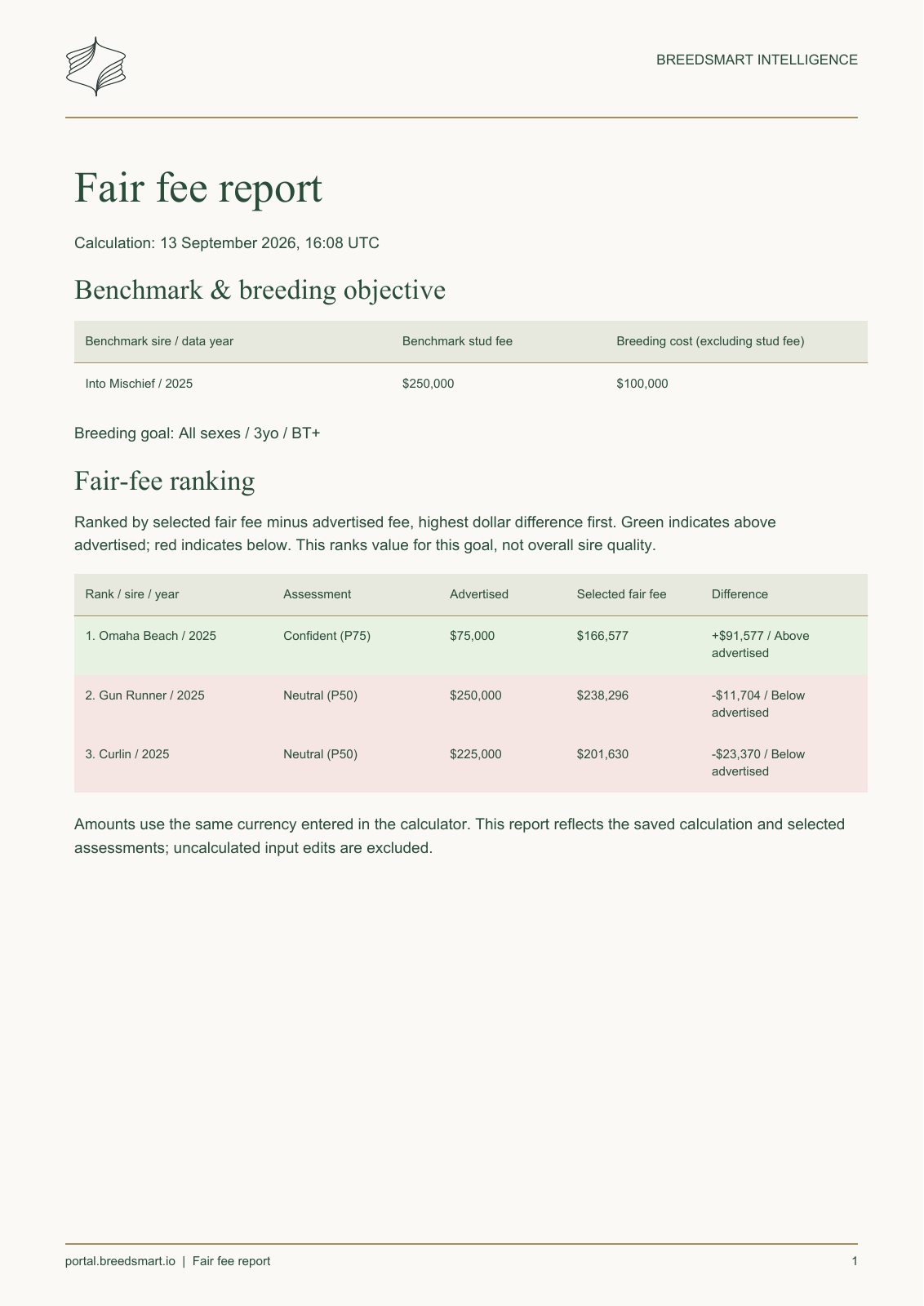
Keep the comparison.
Reports make it easier to revisit assumptions and discuss a shortlist with your breeding team.
Historical sample report illustrating the format. Click to enlarge.
02 · Plan a mating
Explore racing potential and market expectations.
Hypothetical mating
Explore the estimated racing-success distribution for a sire and mare, including available unproven sires.
- You enter
- The sire and mare names, choosing the specific mare from the search results.
- You receive
- A success-probability distribution and an uncertainty interval for the available racing goal.
- How to use it
- Compare both the estimated probability and its uncertainty. The result describes a possible mating rather than guaranteeing the outcome of an individual foal.
Example: evaluate Gun Runner × Puca and compare it with another sire for the same mare.
Open in WorkspaceYearling price estimation
Explore the range of sale prices expected for a pedigree.
- You enter
- The sire, dam and yearling sex.
- You receive
- A sale-price distribution and a table of prices at different market-assessment levels.
- How to use it
- Consider where you expect the yearling to sit within its pedigree’s price distribution. A high assessment is relative to that pedigree’s expectations, rather than an absolute dollar price.
Example: estimate prices for a colt by Into Mischief out of Grazie Mille, then compare the range with your own market expectations.
Open in Workspace03 · Buy a yearling
Bring your shortlist, assessment and budget together.
Yearling valuation
Select yearlings from a sale catalog or enter pedigrees manually, then compare their estimated racing opportunity with their estimated prices.
- You enter
- Two to ten yearlings, a market assessment for each, and a campaign cost per yearling through the end of the 3yo campaign.
- You receive
- A sortable table showing estimated success probability, estimated sale price, five purchase-price levels, and the difference between fair price and estimated sale price.
- How to use it
- Use the prices to compare success per dollar within your selected group. Green differences indicate estimated market prices below the group-relative fair price; red differences indicate prices above it. Adding or removing horses changes the group reference.
Example: select yearlings from Keeneland September or Saratoga, assign your market assessments, and compare the shortlist before setting bidding limits.
Open in WorkspaceAn actual yearling comparison
Gun Runner × Puca and Into Mischief × Puca, using different market assessments. These are example results; your inputs determine your comparison.

Click the preview to view it at full size.
Explore your own options.
Open the Workspace to see available tools and account access.
Open BreedSmart Workspace